
14. Accounting and Invoice Run
Club owners find the menu item Accounting - the central place for invoice runs, open items and accounting exports. The familiar per-aircraft invoice run in the logbook remains available; both use the same logic.
14.1 Invoice run for the whole club
In the Invoice Run tab you pick the club, the aircraft (empty = all), individual members if needed (empty = all; inactive members are selectable), the period (prefilled with the previous month) and which invoice types to create: member invoices and/or instructor invoices. This also allows invoicing a single member across all aircraft of the club - or creating only the instructor invoices.
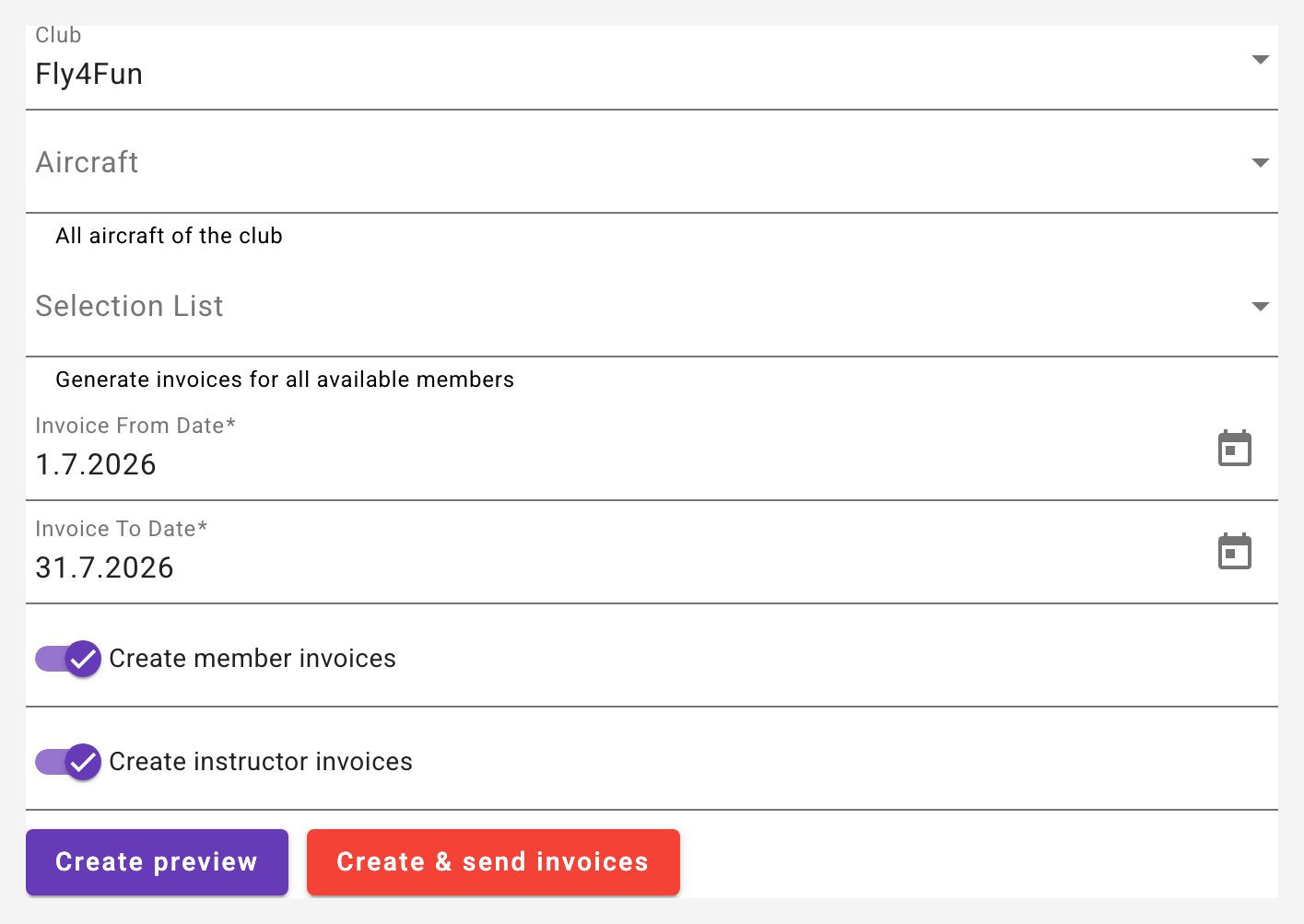
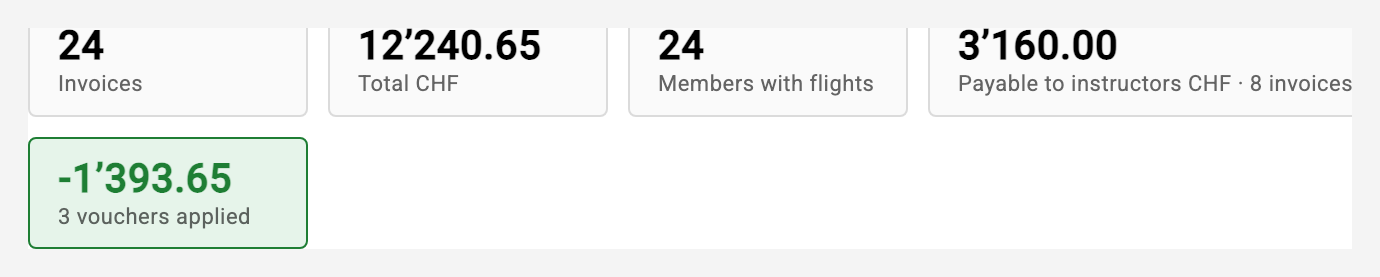
Create preview calculates everything without saving or sending anything: summary tiles show the number and total of invoices, affected members, the amounts payable to the instructors, applied vouchers and billed packages. The total is the amount the club charges its members - the instructor amounts are shown separately.
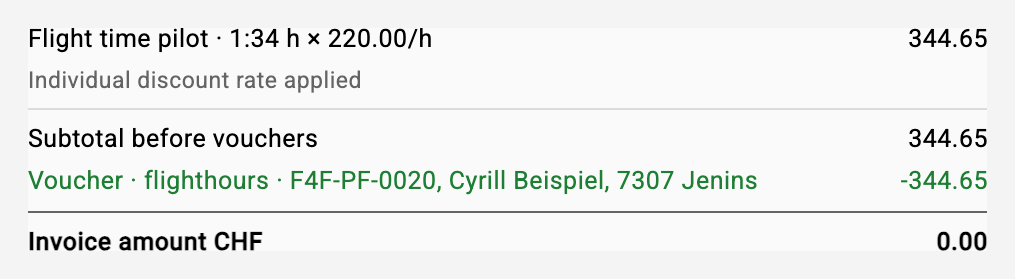
Every preview row can be expanded and shows the complete cost details: flight minutes times hourly rate (pilot, student, instructor including the time model), applied discount, billing packages, VAT and every deducted voucher with its remaining balance - exactly the same calculation that ends up on the PDF.
Create & send invoices then creates the invoices aircraft by aircraft - the progress is visible per aircraft, and the finished PDFs can be opened directly from the result list. Each member receives the invoice as usual (see 14.4).
Good to know: If a member flew on several aircraft in the period, an hour credit voucher and the purchase price of a billing package are correctly applied only once in the preview - in aircraft order, exactly like the effective run.
Periods already invoiced: If an invoice already exists for a member and aircraft whose period overlaps the run - for example after leaving the club mid-month with an invoice up to the day of leaving - the preview shows it right in the row: which invoice, which period, how many days overlap. The row is then excluded and does not run, so the same flights are not invoiced a second time. To run it anyway, tick the box in the Run column; the preview recalculates immediately.
Non-homebase fuel: If the club bills fuel bought away from home, the preview lists the uplifts that are still open, grouped by aircraft - who refuelled when and where, and how much. Generate vouchers asks for the price per litre or gallon and creates the vouchers for all uplifts of that aircraft; they are dated on the flight day and therefore fall into the current period. The preview then recalculates and deducts them. Uplifts that should not go through a voucher can be removed from the list with the icon next to it.
14.2 Invoice run in the logbook
The per-aircraft run (logbook → printer icon) now shows the same summary tiles and the expandable cost details. Two things are new:
- Create instructor invoices: the checkbox is on by default. Deselect it if you e.g. only want to recreate the member invoice of an instructor without sending his instructor invoice to the club again. Conversely, the member invoices can be deselected to create only the instructor invoices; at least one of the two types must be selected. The Regenerate action in the invoice list does the right thing automatically: a member invoice is recreated without the instructor run, an instructor invoice without the member run.
- Inactive members appear in the selection list (marked "(inactive)") - if you deactivate a member and only invoice at the end of the month, you can still select them.
14.3 Open items
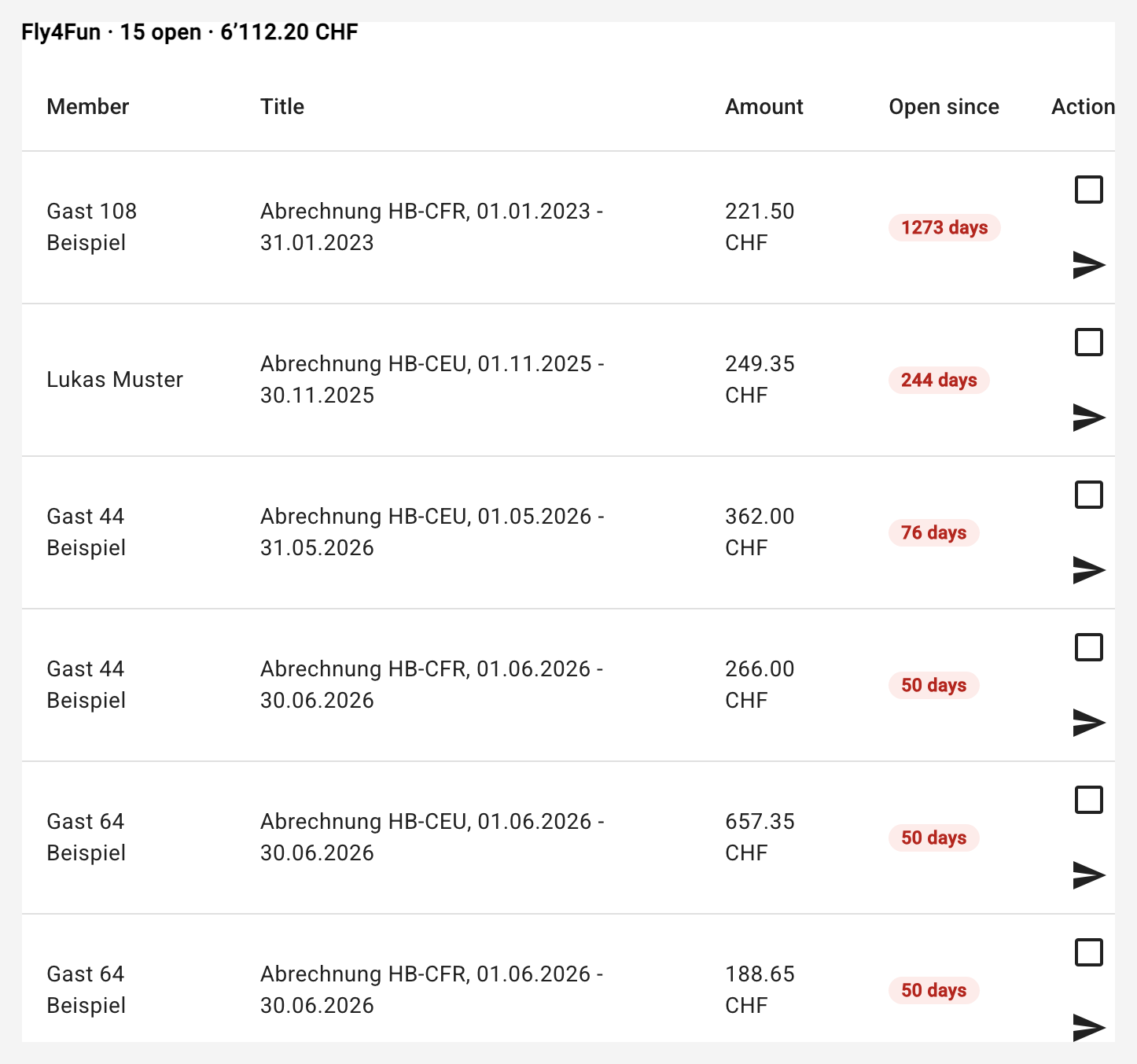
The Open Items tab shows the club selected in the dropdown at the top - the same club selection as for the invoice run and the exports. At the top are the activity key figures of the current month across all aircraft of the club: number of flights, flight time, instruction time and the number of different pilots/students.

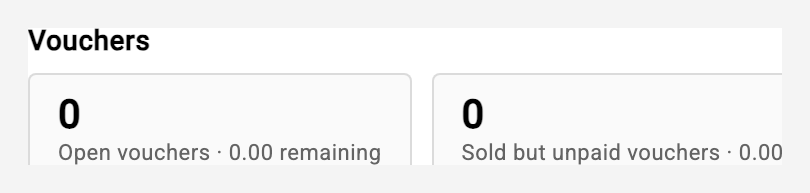
Next to them are the voucher key figures: open vouchers (remaining balance still to be flown) and sold but still unpaid vouchers.
Below follow all unpaid invoices of the club across all aircraft, oldest first; invoices open for more than 30 days carry a red age mark. Directly from the list an invoice can be marked as paid or re-sent.
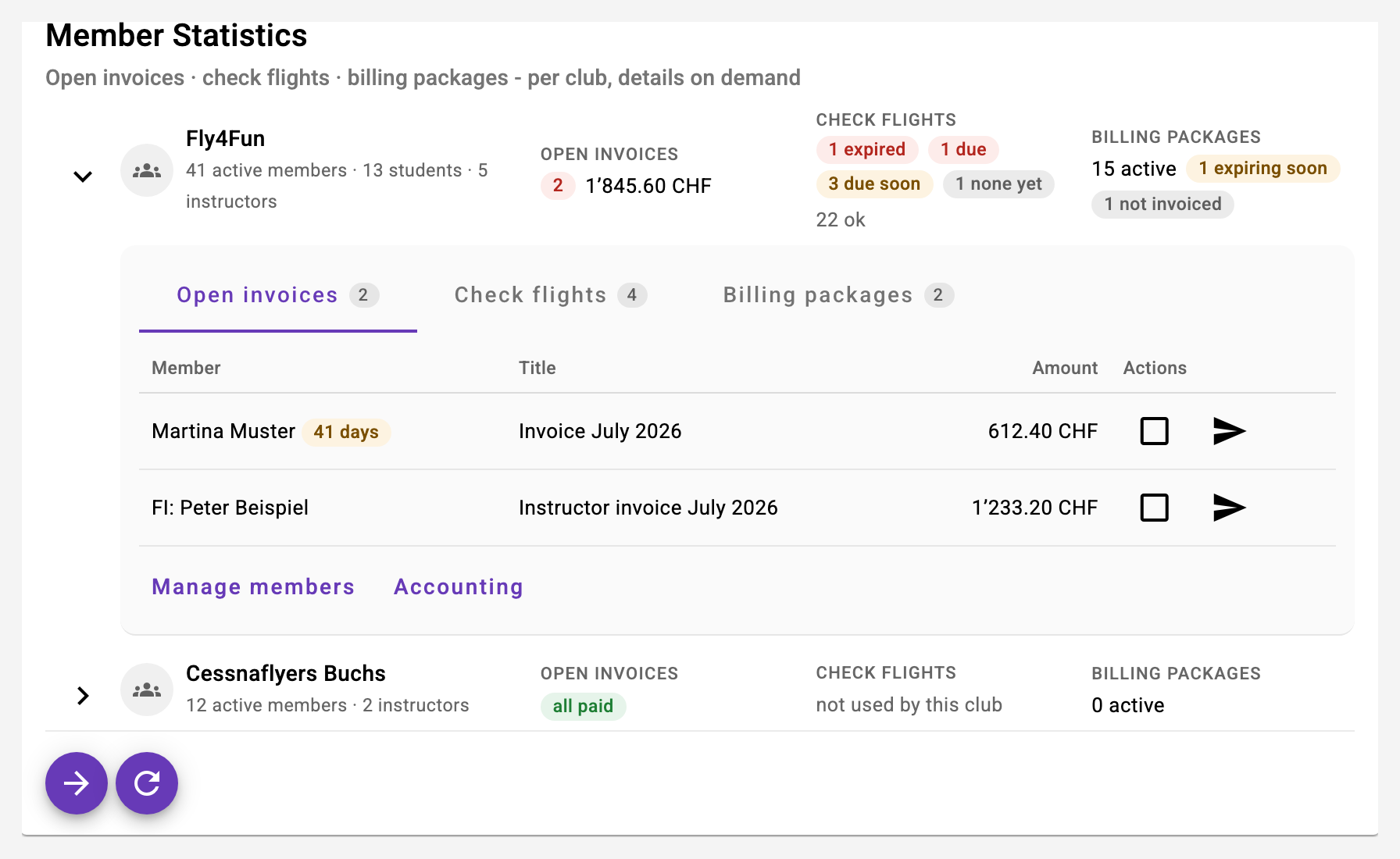
The same overview is part of the Member Statistics card on the dashboard - expandable per club, with the same buttons, for club owners only (see 25).
14.4 Delivery: push and e-mail
When creating and when re-sending, the member now additionally receives a push notification ("New invoice from ...") - clicking it opens the invoice directly as a PDF. The link in the e-mail also leads directly to that invoice. The notification type can be switched off individually under notifications (see 9.3).
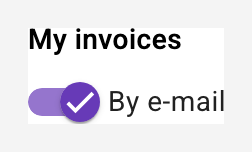
The e-mail can be switched off there as well ("My invoices") - but it is only actually suppressed if at least one device is registered for push notifications. Without a registered device the e-mail is sent anyway: an invoice must never get lost. Instructor invoices continue to go to the club by e-mail; the instructor additionally receives the push notification.
14.5 Exports for bookkeeping
The Exports tab creates one file for the whole club (all aircraft) in one of the three formats CSV, MT940 or ISO 20022. You choose what goes in: member invoices, instructor invoices (marked as expense), voucher sales (as income, with the payment date) - and whether only pending invoices are exported. The CSV now carries a header line with type, currency and status columns, making it directly usable in spreadsheets or accounting software.
14.6 Report: VAT, instructors and marginal activity
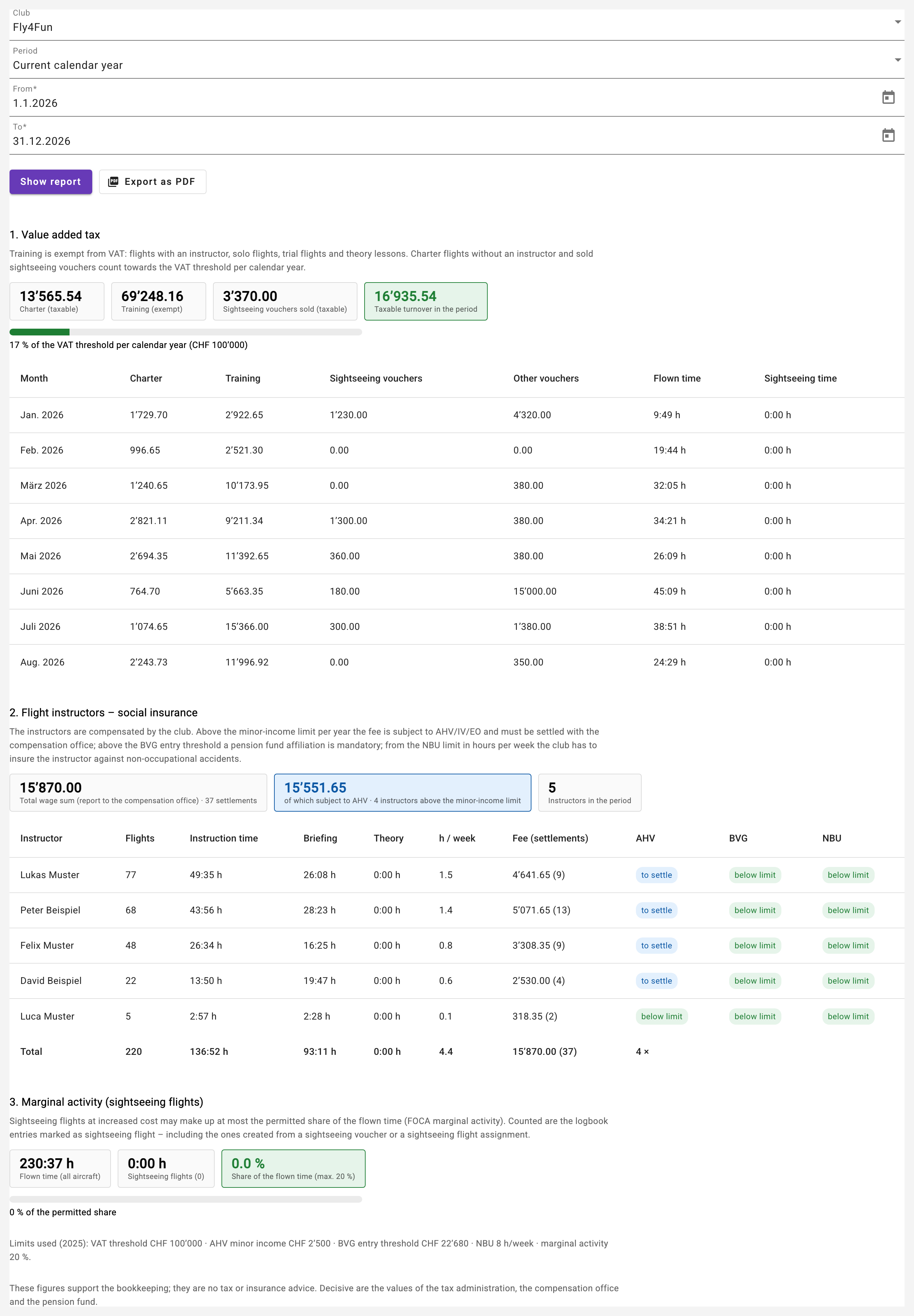
The Report tab summarises for one period what the bookkeeping needs at the end of the year - for one club, selectable as current or previous calendar year, last twelve months, current quarter or a custom period. Show report calculates the figures, Export as PDF delivers the same figures as a document for the accountant.
Value added tax. For a flight school everything related to training is exempt from VAT: flights with an instructor, solo flights of student pilots, trial flights and theory lessons. Charter flights (without instructor) and the sale of sightseeing vouchers remain taxable. The report splits every invoice into a charter and a training share based on its flights, shows both sums per month and the taxable turnover against the threshold of CHF 100'000 per calendar year - green below 80 %, yellow up to 100 %, red above. The invoicing itself stays unchanged; nothing has to be marked separately.
Instructors. Per instructor the report lists flights, instruction, briefing and theory hours, the derived hours per week and the compensation paid by the club (sum of the instructor settlements of the period). Three markers show where social insurance has to be checked: AHV above the minor-income limit (CHF 2'500 per year - settle with the compensation office), BVG above the entry threshold (pension fund affiliation), NBU from eight hours per week (insure against non-occupational accidents). The limits used are printed in the report; the authorities' values are decisive. Above the table stand the total wage sum (all instructor compensations of the period) and the part of it subject to AHV - the sum that is reported to the compensation office and settled on account; the table closes with a total row. In the PDF, sections 2 and 3 each start on a new page.
Marginal activity. A club registered with the FOCA for marginal activity may offer at most 20 % of its flown time as sightseeing flights at increased cost. The report shows the flown time of all aircraft, the sightseeing time and the share against this limit. A sightseeing flight is a logbook entry with the switch Sightseeing flight (marginal activity): it is set automatically when a sightseeing voucher is redeemed or a sightseeing flight assignment is completed; by hand only the club owner or a member classified as sightseeing pilot can set it - sightseeing flights with relatives and friends belong here as well.
14.7 Payment reference on the invoice
Every QR-bill now carries a payment reference - an identifier that designates this one invoice, for example RF07 AHR2 4984. It appears on the payment part, in the invoice header, and in the invoice list below the period.
What it is good for: Anyone who scans or photographs the QR-bill in e-banking automatically carries the reference along - it therefore comes back on the bank statement. When reconciling incoming payments, it tells you at a glance which payment belongs to which invoice, even when two invoices have the same amount. Previously there was only a text such as "Invoice HB-CEU, 01.08.2026 - 31.08.2026", which the payer could overwrite.
There is nothing to configure. The type of reference is decided by the IBAN the invoice is drawn on: an ordinary account produces a reference of the form RF... (creditor reference), a QR-IBAN produces a 27-digit QR reference. If you order a QR-IBAN from your bank and enter it in the club settings or on the aircraft, you automatically get the QR reference from then on.
Voucher invoices carry a reference as well. It is not to be confused with the voucher number (e.g. F4F-RF-0028) printed on the voucher itself.
What stays without a reference: Invoices sent before the introduction keep their PDF and do not get a reference afterwards - the recipient already holds a document without one. In the preview there is no reference yet as long as the invoice does not exist; it comes into being with the invoice. When regenerating an invoice that already exists, it is visible in the preview too.
IBAN check: When saving an IBAN - in the club settings, on the aircraft or for individual instructor billing - it is now checked for validity. A transposed digit is caught immediately instead of only when an invoice can no longer be produced. The IBAN may be written in groups of four as usual.
14.8 Payment reconciliation with the bank statement
Optional module. Instead of marking every payment as paid by hand, you upload the bank statement from your e-banking - the app matches the incoming payments to the invoices via their payment reference.
How it works: In e-banking, download the bank statement as camt.053 for the desired period (some banks call it "credit notification camt.054"; both work, as do several files or a ZIP at once). In the Payments tab, choose the file and click Check file. A preview appears - nothing is stored yet. Only Book writes.
What the preview shows: Tiles with the number of credits, how many are matched unambiguously, how many need confirmation and how many stay without a reference. Below that, every credit with date, payer, reference, amount and assignment.
Only the unambiguous ones are ticked: reference found, amount exact to the cent, invoice open. Everything else is a suggestion you confirm yourself - better one more click than a wrongly closed invoice. The states:
- matched - will be written when you book.
- amount differs - partial payment (the invoice stays open, the rest is visible) or overpayment (the invoice counts as paid).
- suggestion - no reference, but amount and payer name match an open invoice.
- already paid - the reference hits an invoice already marked as paid. Possibly a double payment.
- reversal - an earlier payment was taken back.
- no reference - membership fee, donation, refund. If you want to book it anyway, tick it; it is then stored without a document.
What gets booked: The invoice receives the value date from the bank as its payment date, not the day of the click. Voucher invoices are treated the same way.
What is stored - and what is not: The uploaded file is never kept. A bank statement contains everything that happens on the account; the whole file is read, but only the credits are stored. Debits, bank charges and private movements are counted and discarded. Payments without a document reference disappear by themselves after 90 days; matched ones stay as long as their invoice - they are its proof of payment.
Uploading the same file twice changes nothing. Every booking carries the bank's own reference; one that is already booked is recognised as such and not offered again. This also holds when two statements overlap in time.
Wrong statement: If the account in the file is none of the club's accounts, a warning appears with the (shortened) account number. Check whether you picked the right file.
Undoing an assignment: In the list of booked payments there is an undo icon per row. The payment is deleted and the invoice is open again, unless another payment covers it.
What the module does not do: It never initiates payments and needs no bank contract, no interface and no credentials. The route deliberately goes through a file you download yourself.
14.9 Paying out flight and theory instructors
Part of the payment reconciliation module. If you have been typing your instructors' settlements into your e-banking one by one, you now create them as a single payment file and upload that file in your e-banking.
The app never triggers a payment. It creates a file in the pain.001 format that every Swiss bank understands. You release the payment as usual in your e-banking, with your two-factor confirmation. No bank contract, no interface and no credentials are needed.
How it works: The Payouts tab lists the club's instructor settlements. Use Settlements from and until to narrow the period - the last twelve months are preselected so the list stays readable; what counts is the period the settlement covers, not the date it was created. Everything that can be paid out today is ticked. Optionally set an execution date - leaving it empty means "as soon as possible". Then click Create payment file: the file is offered for saving right away, and you upload it in your e-banking where it says "import payments", "file upload" or "pain.001".
Three states, not two:
- open - nothing has been initiated yet.
- submitted - the file has been created. That is not yet a payment: your e-banking may reject it, and you may leave it untouched.
- paid - the money has left the account, with the date of the debit.
The return path runs by itself: Every payment in the file carries an identifier that the bank returns on the bank statement. At the next payment reconciliation the app recognises the debit by it and sets the settlement to paid - with the bank's value date. You need do nothing beyond uploading the statement as usual.
Confirming by hand: If you keep transferring yourself or do not want to use the file, tick the settlement as paid with the check symbol. The undo symbol takes the confirmation back.
Where the account number comes from: From the instructor's individual instructor billing (member management, step "Role and classification"). The list shows it shortened - a full account number does not belong in an overview.
If a settlement cannot go into the file, the reason appears in its row and it cannot be ticked:
- no IBAN on file - the instructor has no individual billing IBAN.
- the IBAN cannot be read - most likely a transposed digit.
- a QR-IBAN cannot receive this payment - a QR-IBAN requires a QR reference and is meant for receiving invoices, not for payouts. The instructor enters their ordinary IBAN there.
- the amount is zero - there is nothing to pay out.
Anything that is left out for another reason is reported row by row after the file has been created - an already paid settlement, for example.
What the file contains: The recipient's name and account, the amount, and the title of the settlement as the message, so the instructor can see on their statement what the money is for. The club's account comes from the club settings. A recipient address is deliberately not included - a domestic payment does not need one, and an incomplete address would be rejected from November 2026 onwards.
The club's bank statement shows a single collective debit instead of many individual entries - the file requests it that way on purpose.
14.10 Payment reminder
Part of the payment reconciliation module. If you want it to, the app reminds members about open invoices - once per invoice, by e-mail and push.
By default no club sends reminders. The deadline is the switch: as long as Payment reminder after (days) in the club settings, step Billings, is empty, nothing happens at all. Enter 30, for example, and every invoice that is still open 30 days after its invoice date is reminded.
Check first who it would affect. The Open items tab in accounting has a Payment reminder section. There you can try a deadline without saving it - the list shows exactly the invoices that this deadline would remind today. Nothing is sent from that page; reminders only go out once the deadline is saved in the club settings.
Once only, never a second level. Anyone who does not pay after the reminder needs a conversation, not another automated message. The date of the reminder stays on the invoice.
An old backlog does not cause an avalanche. Reminders only go out within 30 days after the deadline has passed. So if you switch reminders on today, it affects the current month - invoices that have been open for half a year are left alone.
Who receives no reminder:
- anyone who has paid part of it - a booked partial payment shows that the person has responded.
- instructor settlements - that is a debt of the club, not a claim against a member. They live in the payouts tab.
- invoices without a PDF - what was never sent is never chased.
- anyone who turned off invoice e-mails - the push still arrives, it has its own switch on the notifications page.
Why this belongs to the module: A reminder is only as reliable as the payment status it rests on. With payment reconciliation, "paid" is a fact from the bank statement instead of someone's recollection. That is why the field only appears with the module licensed - otherwise a forgotten manual entry would chase somebody who paid long ago.
What the message contains: title, date and amount of the invoice, the payment reference (if the invoice already carries one) and a link that opens it directly. Plus a note that all is well if the payment happens to be on its way.